


⚡ At a glance
Binance and Coinbase are the two largest crypto exchange platforms in the world. If you need to choose right now: Binance wins on costs and on the variety of available coins; Coinbase wins on simplicity and regulation. If you want to start without complications, Coinbase is the right pick of the two; if instead you want lower fees and already have experience with crypto, go for Binance.
Binance vs Coinbase: area-by-area comparison
Score from 0 to 5 based on direct use of both exchanges
Strengths: Binance vs Coinbase
Binance
- Spot fees among the lowest on the market (0.10% base, cut by 25% when paying in BNB)
- Vast crypto catalogue and advanced markets (futures, margin, copy trading) — some restricted for UK retail
- Wide Earn suite with many stakeable assets and modest fees
- Fast execution, including on altcoins
- A complete ecosystem inside a single account (spot, derivatives, Web3 Wallet, P2P)
Coinbase
- An immediate interface, ideal for beginners
- Solid regulatory profile: US-listed company, FCA-registered in the UK
- 1:1 client reserves, no lending of deposited assets
- 24/7 chat support and guided journeys for first-time users
- Passive yield on USDC
When to choose Binance and when Coinbase?
Three different answers depending on your profile
Binance
Choose Binance if…
- You want to pay as little as possible in fees
- You want lots of cryptos and advanced features
- You're comfortable with a denser interface
Both★ The most common choice
Choose both if…
- You want to diversify risk (if one platform has technical issues or freezes, your assets on the other stay accessible)
- You want to use the best of both: Coinbase to buy the major coins simply and safely, Binance for active trading, smaller altcoins and advanced tools
Coinbase
Choose Coinbase if…
- You want maximum simplicity
- A reassuring regulatory profile is your priority
- Paying a little more isn't a problem
Worth keeping in mind: in the UK, gains on disposals of crypto are generally subject to Capital Gains Tax and must be reported to HMRC; running two exchanges doubles the complexity of tracking your transactions for tax.
Security and regulation
In the UK, crypto firms must register with the FCA under the Money Laundering Regulations, and any financial promotion to UK consumers must be made or approved by an FCA-authorised firm. Both exchanges apply industry-standard measures such as cold storage, 2FA and withdrawal whitelists, but their UK regulatory standing is very different:
Binance
Binance is not authorised or registered with the FCA to carry out regulated activity in the UK; its former UK arm, Binance Markets Limited, surrendered its FCA permissions in 2023. UK users are served under "Section 21" arrangements via an FCA-approved promoter, new sign-ups must pass an FCA-mandated appropriateness test, and certain high-risk products (some derivatives and Earn products) are restricted or unavailable for UK retail customers. On the security side its measures are solid (cold wallets, two-factor authentication and a 1-billion-dollar emergency fund, the so-called SAFU, to protect users).
In the past Binance has clashed with regulators around the world (above all in the United States) and has suffered real, significant hacks. So far, however, it has always reimbursed affected users.
Coinbase
Coinbase is registered with the FCA and offers GBP deposits and withdrawals via Faster Payments. Its parent company is listed on the NASDAQ, so it is subject to rigorous corporate-governance controls.
Overall it's a secure platform: a simple interface suitable even for beginners, and 98% of funds kept in cold storage (offline), hard to hack.
Coinbase states that it keeps client crypto in segregated custody (Proof of Reserves): it doesn't mix it with company funds, doesn't lend it and doesn't invest it. If every client asked to withdraw everything tomorrow, the crypto would be there.
A cyber-attack occurred in 2025 in which personal and sensitive data of some users was leaked. Banking details, passwords and funds were not touched, but it's a precedent worth keeping in mind.
Both are custodial exchanges: they hold the private keys. The principle "not your keys, not your coins" applies. If you want full control, you need to withdraw to a self-custody wallet. Both also offer their own non-custodial wallet.
Coinbase moves almost $3.5 billion a day, while Binance moves over $13 billion. Those numbers say something important: these are live, liquid exchanges, with buyers and sellers always active. You can enter and exit the market quickly, without the risk of finding it frozen. And with hundreds of millions of users behind them, the risk of a sudden disappearance, typical of smaller exchanges, is very low.
If high volumes are a signal of reliability, real security is measured by factors such as regulation, how funds are held in custody, transparency and the track record of incidents. And on that front, Coinbase wins.
| Feature | Binance | Coinbase |
|---|---|---|
| Proof of reserves | Yes (Merkle tree) |
|
| Cold storage | Yes | Yes (+ Vault) |
| Protection fund | SAFU (emergency fund) | Fiat USD in insured bank accounts |
| 2FA / whitelist | Yes | Yes |
| UK regulatory status | Not FCA-authorised; served via approved promoter | FCA-registered |
| Breaches suffered |
| May 2025 data breach |
Supported cryptocurrencies
Binance offers the widest variety of cryptocurrencies and tokens on the market, while Coinbase takes a more cautious, regulated approach, though it still covers the main cryptocurrencies and many emerging assets broadly.
The difference matters little for those investing mainly in the major cryptocurrencies with a long-term horizon, but it becomes important for anyone who wants access to altcoins, emerging tokens and advanced trading features.
Binance
It offers one of the broadest asset selections in the sector, with over 500 cryptocurrencies and more than 1,500 trading pairs available (the selection available to UK users may vary).
Beyond traditional trading, the platform lets you buy and sell crypto through the P2P marketplace, which supports over 800 payment methods and more than 100 fiat currencies, letting users trade directly with each other, choosing the price and payment method.
It also integrates numerous additional services, including yield programmes on over 300 cryptocurrencies, staking, access to new tokens through the platform's launch initiatives and a dedicated NFT marketplace.
Coinbase
It supports around 450 cryptocurrencies. For more experienced users there's Coinbase Advanced, the exchange's advanced trading platform, which offers more than 550 spot pairs, maker fees as low as 0% at the highest volumes, advanced and customisable charting tools, and access to derivatives markets in the jurisdictions where they're available.
Coinbase also lets you earn yield by staking various cryptocurrencies, with APYs that can exceed 13% depending on the asset and market conditions.
Costs and fees
Binance
The base fee is 0.10% for both maker and taker, already low in itself. But the first move to make is to enable paying fees in BNB: they drop to 0.075% with one click, with no volume requirement. GBP deposits and withdrawals via Faster Payments are typically free or low. If you use a card to deposit, on the other hand, it costs around 1.8–3% — a charge that's far from trivial. Binance applies no fees on crypto deposits, and crypto withdrawals carry a fixed per-network fee (for BTC, about 0.0002 BTC), which varies with blockchain congestion. Nothing dramatic, but worth keeping an eye on.
Coinbase
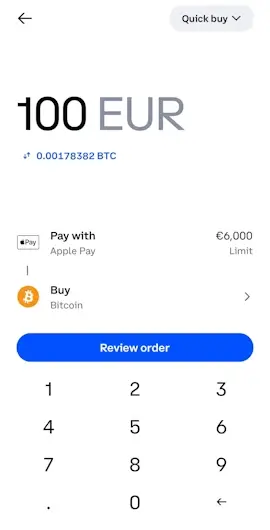
Coinbase has a simple interface (the one most people use), with a spread plus a variable fee that, on small amounts, can work out expensive — convenient but costly.
If you want to trade seriously, you need to switch to Coinbase Advanced Trade, the crypto platform for experienced traders: there you work with maker/taker, and the base cost is 0.60% maker / 1.20% taker — still quite a bit higher than Binance. Fees fall with volume, but you need very large amounts to get close to Binance's levels. The good part: GBP deposits and withdrawals via Faster Payments are free.
So which is cheaper, Binance or Coinbase?
If you buy and sell often, Binance costs you far less than Coinbase, and if you keep some BNB in your account you get an extra 25% discount automatically.
If instead you buy occasionally and sit tight (say £100 a month in Bitcoin), both are fine. On Coinbase you pay a spread plus fee (which, on small amounts, is still expensive in proportion). On Binance it's worth funding by bank transfer and placing a limit order, otherwise costs creep up there too.
The most common problem with Coinbase is that almost everyone uses the basic app without knowing there's an advanced version with lower fees. Switching to it is free and instant, but the fees still end up higher than Binance's.
When does it make sense to use Coinbase? Mostly if you want something simpler to manage. On the cost of trades alone, Binance wins.
One rule holds for both: always deposit by bank transfer (Faster Payments), never by credit card. With a card you pay an extra deposit fee that eats into your margin straight away.
Platforms and app
Binance
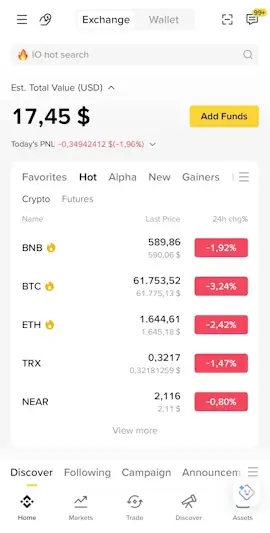
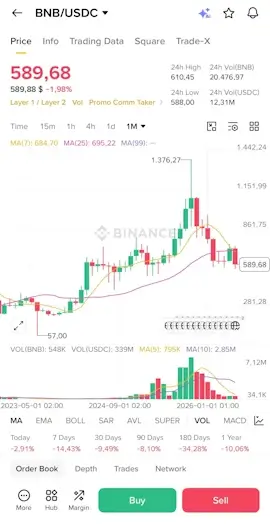
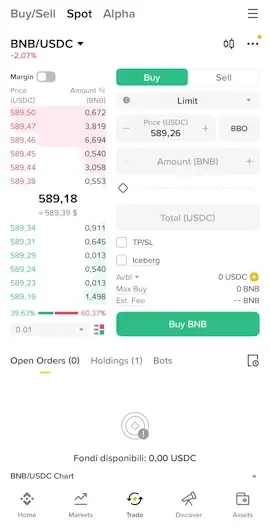
It's available via browser, desktop app and mobile. The site works well both on phones and on large screens. The mobile app is comprehensive and well rated (4.6 on Google Play, 4.7 on the App Store). It has two distinct modes: Lite and Pro. Lite mode is clean and focused on basic operations, designed for beginners. Pro mode is the one for traders: it has an order book, integrated TradingView charts, real-time data, advanced technical analysis and a portfolio-management tool called Portfolio Insights. You can switch between them with a toggle.
For newcomers, Binance can feel complex at first, given the enormous amount of features available. The menu is packed: spot, futures, earn, launchpad, NFT, bots, P2P, margin. If you don't know what you're looking for, it's easy to get lost. But once you've learned the structure, everything is quick to reach.
The analysis tools are serious: integrated TradingView, order book, technical indicators, market depth. Features that would usually require external platforms, but here you find them all included and well integrated.
Coinbase
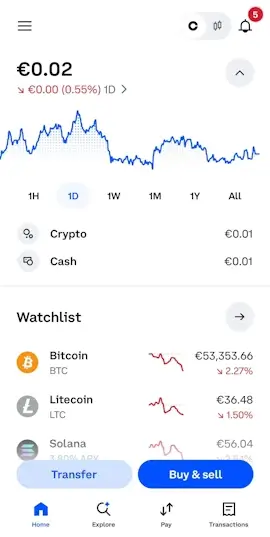
Available via browser and iOS and Android apps. It doesn't have a dedicated desktop app.
The interface is very simple, while still keeping full functionality and security.
Besides the "main" app used to buy, sell and swap crypto, there's also Coinbase Wallet, a standalone app designed to store, manage and interact with your own crypto. It's available on iOS and Android, or in the browser or as an extension.
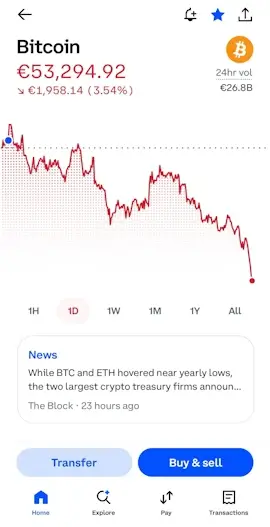
The app comes in two clearly separated versions: the basic app and Coinbase Advanced. The first aims to make buying crypto immediate and simple, even for beginners. The charts are easy to read, operations are stress-free and the various accepted payment methods add a lot of convenience.
The second is built for seasoned traders, with a more complex interface, limit orders, an order book and advanced order types. The charts are integrated with TradingView.
Both are free, and you can switch from one to the other within the same account with a toggle.
Coinbase also offers a subscription plan, Coinbase One, available in three tiers from about £4 a month. The benefits it offers are zero trading fees up to a certain threshold that varies by plan, boosted staking rewards, priority 24/7 customer support and onchain partner offers.
My view is that if you buy crypto regularly with the basic app and your monthly trades top £300–400, the subscription makes sense because it pays for itself. On £500 of purchases, the basic app would cost you around £10–15 in fees. At ~£4 you're already saving. If instead you buy occasionally, it isn't worth it.
If you're a beginner on Coinbase, you have two paths. You use the basic app, which is simple and intuitive but charges high fees. Or you switch to Advanced to pay less, but you're faced with an interface with charts, an order book, limit orders and a level of complexity that isn't designed for someone starting out. Coinbase One tries to plug this gap, but it's a partial fix: you pay a monthly subscription to make tolerable a mode that's expensive to begin with.
On Binance this problem is less evident, because Lite mode is as simple as Coinbase's basic app, but the base fees are already lower for everyone, beginners included. You don't have to become an expert trader to pay lower fees.
Services
In practice, Binance tends to cover almost every crypto need in a single environment, while Coinbase aims to cut complexity and make the experience more immediate.
Binance
Binance is that platform you enter to trade and can end up using for practically everything: spot, derivatives, staking, earn, NFT, P2P. The feeling is exactly that of a very dense ecosystem, where every function is within reach. This is an advantage if you already know what you're doing, because you have plenty of choice and advanced tools, but at the start it can feel a bit scattered and not always immediate. (Note: some products are restricted for UK retail customers.)
Unlike Coinbase, it doesn't offer a crypto card (for now the Binance Card, with 3% cashback, is available only in some countries, and the UK is not included). If you want a linked card to spend your crypto directly from your balance in shops, you'll be disappointed.
Coinbase
It's much cleaner and more linear: you open the app and do what you need straight away, without too many options or steps. Even when you switch to Coinbase Advanced, which is the more "trader" part, it stays more orderly than Binance. On the services front it's more essential: staking available but on fewer assets, an NFT marketplace, a wallet and some educational features, and little else compared with Binance's wider ecosystem. But that very simplicity is its strong point, because it reduces the risk of confusion and mistakes.
Coinbase offers the Coinbase Card, a debit card to spend pounds or any cryptocurrency supported by the exchange, accepted wherever VISA cards are accepted (availability and features vary by region — check the official site).
The free Coinbase One Card credit card, which lets you earn up to 4% back in Bitcoin on purchases, is not available to UK residents.
Promotions and welcome bonuses
Offers active at the time of publication, subject to terms, conditions and possible changes
Binance
For new users, Binance offers a welcome package of up to $100 in bonuses and up to 10% rebate on transaction fees. To protect users, it also declares a SAFU protection fund of 1 billion USDC.
Coinbase
Welcome bonus: £15 in Bitcoin when you sign up and complete your first trade. The platform is FCA-registered in the UK, with maker fees from 0% in Advanced mode and a VISA card to spend your balance in pounds or in crypto.
Promotions and bonuses are subject to terms and conditions and may change or end without notice. Always check the latest conditions on the exchange's official site before signing up.
Already have an exchange?
If you already use a crypto exchange, the right question isn't "which is best" but "what am I missing". In the case of Binance and Coinbase head to head, the two exchanges don't fully overlap, and in certain cases keeping both makes practical sense.
I already have Binance, should I also open Coinbase?
It depends on what you want. If you use Binance only to trade and keep your assets there, you probably don't need anything else. Coinbase makes sense alongside it if you want a simpler platform for occasional purchases, if you want an FCA-registered exchange with GBP via Faster Payments, or if you prefer the reassurance of a publicly listed, regulated provider. Some users keep Coinbase just as a "shop window" for their portfolio, for its clean interface and established reputation. Moving crypto between the two exchanges incurs the usual network fees.
I already have Coinbase, should I also open Binance?
If you've stayed on Coinbase's basic app and pay fixed fees on every purchase, opening Binance is probably the most concrete move you can make to save money. The fees are structurally lower and, just by enabling payment in BNB, you save on every operation. Beyond costs, Binance offers staking on hundreds of assets, futures, margin trading, automated bots and a launchpad for new tokens (some products are restricted for UK retail users). If you've gained a bit of experience and want to do more than simple buying and selling, Binance could be rewarding.
Why use both?
The most common use case is keeping Coinbase for simple purchases and long-term custody (you buy, you hold, you know the platform is solid and regulated) and using Binance for everything else: active trading, staking, advanced features and lower fees.
In practice Coinbase becomes the entry point and the safe drawer, and Binance becomes the place where you really work your assets.
There's also a less obvious advantage: diversifying across two platforms reduces the risk that a technical problem, an account freeze or a regulatory issue on a single exchange locks you out of your whole portfolio at the wrong moment.
Final verdict
In my experience, Binance is the more sensible choice for anyone who wants to trade actively: the fees are structurally lower, and the platform offers more tools, more assets and more flexibility. Anyone who wants to go beyond simple buying finds everything in one place on Binance. In the UK, bear in mind that Binance is not FCA-authorised and operates via approved-promoter arrangements, with some products restricted for retail.
Coinbase is better suited to beginners or to those who want simplicity: the interface is clean and the buying process is immediate. On the regulatory front it's also the more solid option: it's FCA-registered in the UK, has never had serious problems with regulators, and its transparent structure as a listed company makes it more predictable from a compliance standpoint. For those who value institutional solidity, that counts.
Binance, by contrast, carries a complicated regulatory history (a $4.3 billion fine in the US, forced exits from several markets, and no FCA authorisation in the UK). It can still be accessed by UK users via approved-promoter arrangements, but its regulatory profile is less established than Coinbase's.
It's worth remembering that the two platforms aren't mutually exclusive. You can use both, leaning on Coinbase's simplicity for recurring purchases and Binance for operating at lower cost and with advanced features.

Coinbase is today the go-to exchange for those who put security and simplicity first; Binance remains hard to beat on costs and breadth of offering for those who trade frequently. The question to ask isn't which of the two wins the comparison, but which one better fits the profile of the person using it.
Alfredo de Cristofaro Founder of QualeBrokerMade your decision?
Choose the exchange that best fits your profile. Or open both: opening an account is free in both cases.
Binance vs Coinbase: frequently asked questions
Is Binance or Coinbase cheaper?
Binance, generally, thanks to lower spot fees and the BNB discount. On Coinbase, costs are competitive only when using Coinbase Advanced, the platform for advanced traders, not the quick buy.
Is Binance or Coinbase safer?
Both apply high standards. Coinbase offers the transparency of a publicly listed company, with 1:1 reserves, and is FCA-registered in the UK; it also has no major hacks or breaches on record. Binance has the SAFU fund, through which it has already reimbursed users after the 2019 hack. Neither guarantees you invulnerability, and the same rule applies to both: don't keep more in there than you can afford to lose.
Is Binance legal in the UK?
Binance is not authorised or registered with the FCA to carry out regulated activity in the UK; its former UK arm surrendered its FCA permissions in 2023. UK users are served under "Section 21" arrangements via an FCA-approved promoter, new sign-ups must pass an FCA appropriateness test and accept a cooling-off period, and certain high-risk products are restricted for UK retail customers. Coinbase, by contrast, is FCA-registered.
Can I transfer crypto from Binance to Coinbase (and vice versa)?
Yes, by withdrawing to the other exchange's address. You only pay the network fee; make sure you use the same network to avoid losses.