


Gold Forecast 2026
Gold price outlook
Current price
4,294-4,356$
intraday range
End of 2026
4,600$
conservative target
Optimistic Target
6,000$
bullish scenario
Key points
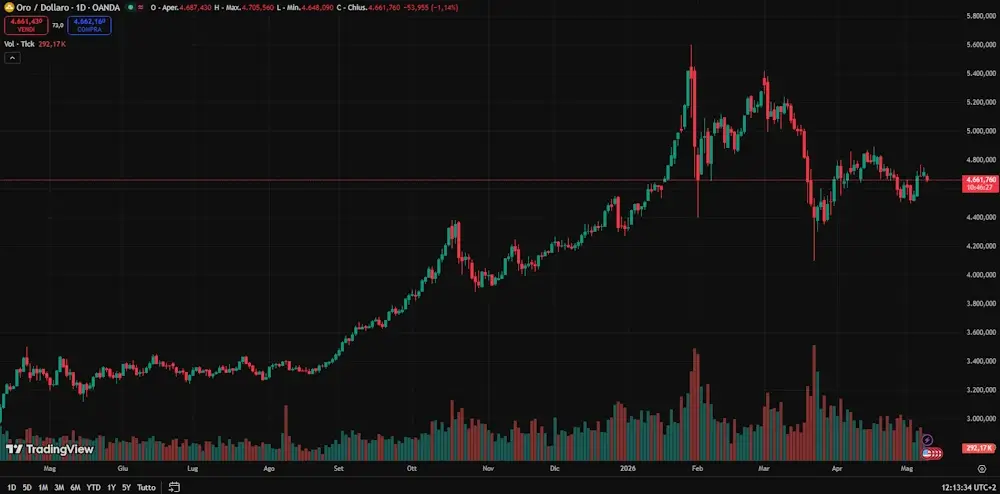
Current price: gold remains in the $4,300 per ounce area, following the sharp correction from the January highs. Silver follows a similar dynamic, supported by the commodity cycle but more volatile.
2026 Target: the most aggressive estimates point to $6,300, while conservative targets indicate a return to the $4,600/$4,900 area.
Main drivers: Federal Reserve monetary policy, bond yields, US dollar, oil prices, inflation, and central bank purchases.
Risks: higher rates for longer or further hikes, strong dollar, ETF outflows.
Investment strategy: gold remains a key long-term asset to hedge against inflation and global economic instability, but in the short term it is highly dependent on monetary policy and yields.
In 2025, Gold experienced one of the most brilliant chapters in its financial history, recording an annual growth of over 60%, a figure not seen since 1979. This exceptional rally was fueled by a mix of dollar devaluation, strategic central bank purchases, and an unprecedented rush to safe-haven assets.
Do the 2026 gold forecasts confirm this trend, or are we nearing a correction? In this article, we will analyze gold price forecasts for the coming months, based on data from analysts at major global institutions such as Goldman Sachs and JP Morgan.
✨ Want to invest in gold? Discover ActivTrades, one of the best online brokers for gold and commodity trading. Take advantage of competitive spreads and advanced platforms to trade CFDs safely, with no hidden fees.

- ✓Trade gold (XAU/USD) with competitive spreads
- ✓Use leverage to amplify your exposure to gold
- ✓Advanced platforms for technical analysis on gold
- ✓Demo account to test your strategies
Gold Forecasts: What was the 2025 trend?
To understand the 2026 gold market forecasts, it is essential to analyze the factors that have shaken the sector over the last year. After an uncertain start at the end of 2024, 2025 marked a historic turning point: in October, the gold price broke through the $4,000 per ounce barrier for the first time.
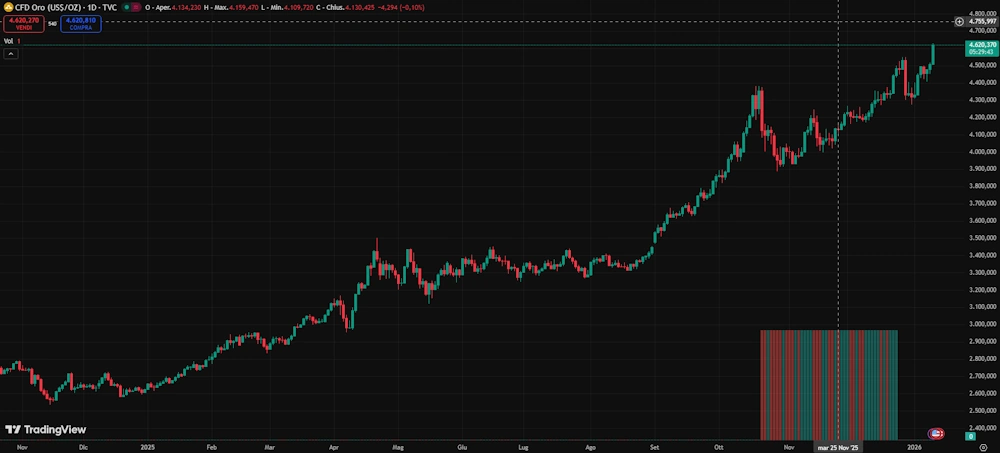
This surge was triggered by several factors such as:
- US trade policies: the aggressiveness of the new US administration generated uncertainty, causing the XAU/USD pair to gain 20% in the first quarter alone.
- Institutional purchases: central banks preferred gold over US Treasuries, viewing the yellow metal as a more stable store of value.
- Safe-haven assets: geopolitical tensions prompted both retail investors and large funds to overweight gold in their portfolios, outperforming major stock indices.
In summary, gold proved to be the strongest commodity compared to other energy assets.
Gold Forecast 2026: Factors that could influence the trend
Gold’s performance this year will be shaped by a delicate balance between physical demand, financial investments, and monetary policy decisions.
The boost from central banks and ETFs
According to HSBC analysts, central banks will continue to be net buyers of gold, especially in emerging economies like China. Simultaneously, JP Morgan estimates that gold ETFs will see inflows of approximately 250 tons in 2026, while demand for physical gold bars and coins will remain above 1,200 tons.
If you are considering adding ETFs to your portfolio, check out our guide to the best 2026 ETFs.
The role of the Federal Reserve and interest rates
Historically, gold benefits from interest rate cut cycles. If the Fed maintains a dovish stance to support the economy, the dollar could weaken further. A weak dollar and falling government bond yields make gold prices more accessible to international buyers, fueling the rally.
Furthermore, new chapters could emerge from the world of cryptocurrencies.
Structural portfolio diversification
It is no longer just a matter of short-term speculation. Experts are noting a structural trend: from Chinese insurance companies to large portfolios linked to the crypto world, gold is being chosen as a stabilizer against extreme volatility.
Gold Forecast: What to expect in 2026?
Long-term forecasts reflect widespread optimism, albeit with different nuances among various analysts.
- JP Morgan forecasts an average annual price of $4,753, with peaks that could reach $5,055 in the final quarter of 2026. Growth could continue up to $5,400 in 2027.
- Goldman Sachs maintains a bullish outlook, indicating a target of $4,900 by the end of 2026, citing monetary easing as the primary catalyst.
- Bank of America (BofA) has raised its estimates to $5,000 per ounce, highlighting how rising debt and US fiscal deficits make gold an essential asset.
- Morgan Stanley is targeting a price of $4,800 as early as the first months of 2026, emphasizing how gold functions as a barometer for global geopolitical risk.
Gold Forecast: Year-end 2026
Although the primary trend remains bullish, HSBC analysts warn that we could witness a wide trading range, fluctuating between $3,950 and $5,050.
The estimated price for the year-end is around $4,450. This slowdown compared to mid-year peaks could be caused by so-called “demand destruction”: when prices become too high, the jewelry sector (which accounts for 40% of total consumption) tends to contract, acting as a natural brake on the price rally.
HSBC’s positive outlook is not limited to gold: the bank has also revised upward its estimates for related metals, bringing the silver target to $68.25 per ounce. For those looking for less expensive alternatives with high potential, it is useful to understand how to invest in silver to capitalize on this bullish phase for the sector.

What is the next step?
Sign up for free on eToro and start investing in gold
Gold Forecast 2026: FAQ
How much will gold cost in 2026?
Most analysts agree on an average price between $4,500 and $4,800, with the potential to reach $5,000 in scenarios of high geopolitical tension.[cite: 1]
What is the gold price forecast for 2030?
While long-range forecasts are difficult to make, the de-dollarization trend suggests that gold will maintain an upward trajectory, potentially stabilizing at new historical lows significantly higher than current levels.[cite: 1]
How much will gold be worth in 2028?
HSBC's future gold forecasts indicate an average price of approximately $4,700 for 2028, reflecting more moderate but steady growth following the 2025-2026 boom.[cite: 1]
When will the gold price crash?
A significant decline could only occur in the event of a peaceful resolution to global conflicts (Ukraine and the Middle East) coupled with a return to very high real interest rates—a scenario that currently appears unlikely.[cite: 1]